
Risk registers have a reputation problem. Too often they become long spreadsheets filled in once and never read. For a small team, that is worse than no register at all, because it creates the illusion that risks are managed.
A useful register is short, current and owned. It names the few events that could seriously disrupt the business, estimates how likely and how damaging they are, and records what is being done about them.
Key facts
- Most small teams need fewer than fifteen active risks on the register.
- Likelihood and impact should be scored consistently, not debated each time.
- Every risk needs one named owner, not a committee.
- Review cadence matters more than the format of the document.
Contents
- What a risk register is for
- Likelihood and impact
- Scoring without false precision
- Assigning ownership
- Review cadence
- Linking risks to controls
- A simple example
What a risk register is for
A risk register is a record of uncertainty that could affect your objectives. It is not a list of every possible bad thing. It is a filtered list of events plausible enough and serious enough to justify attention.
The register helps a team make decisions consistently. It shows which risks are being reduced, which are being accepted and which need more information before a decision can be made.

Likelihood and impact
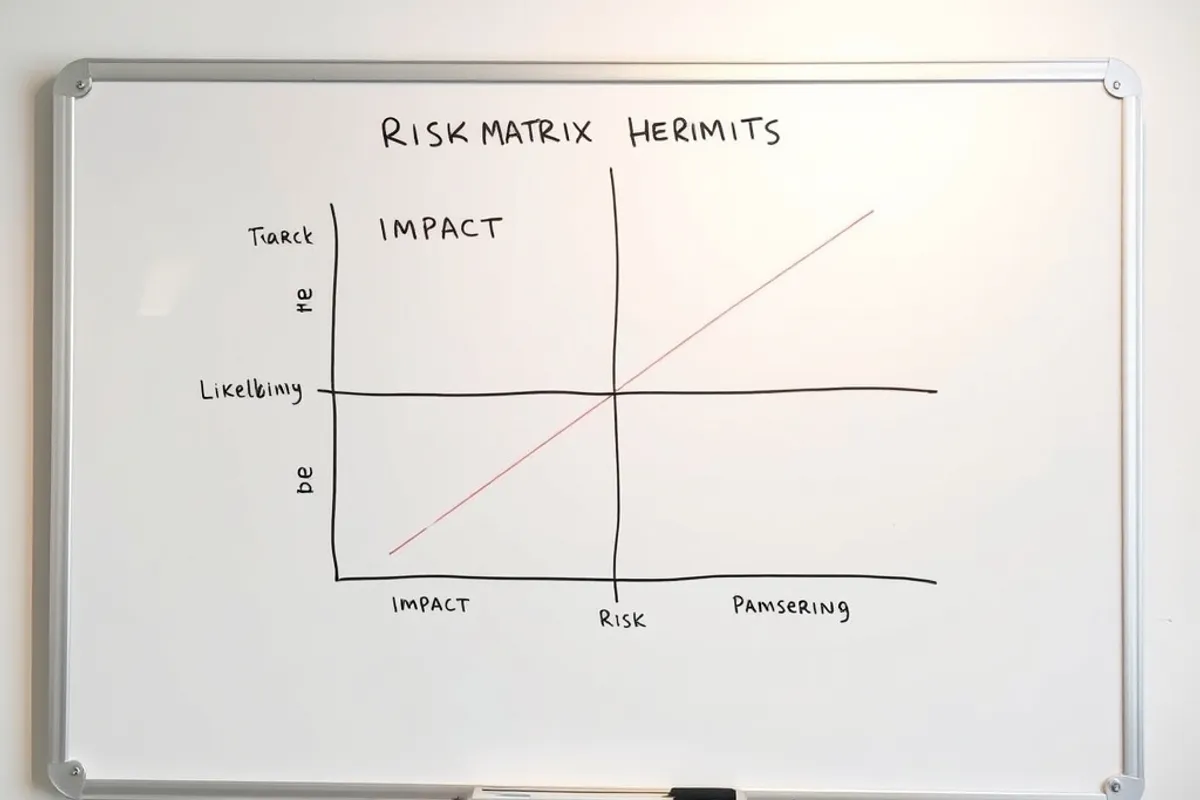
Score each risk on two dimensions: how likely it is and how much damage it would cause. Use a simple five-point scale and define what each point means, so different people score consistently.
For financial risks, impact can be expressed as a range of loss. For operational risks, it may be days of downtime or lost customers. The scale matters less than using the same scale across the register.
Scoring without false precision
Multiplying likelihood by impact produces a risk score that helps prioritise. The number is not a scientific measurement. It is a conversation starter and a way to sort attention.
Avoid spending hours debating whether a risk is a three or a four. Ask instead what evidence would change the score. If the answer is unclear, the team may need more information or a simpler decision rule.
Assigning ownership
Every risk should have one owner responsible for monitoring it and coordinating a response. Ownership is not blame. It is accountability for keeping the risk visible and the mitigation moving.
The owner should have the authority or access to the people needed to act. If a risk sits with someone who cannot influence it, the register will stall.
A risk with no owner is not managed. It is merely described.
Review cadence
A monthly review is manageable for most small teams. The agenda should be short: new risks, changes to existing scores, overdue actions and risks that can be closed.
Review the register after major events such as a funding round, a key hire, a new regulation or a significant customer loss. The world changes faster than the calendar, so the register should change with it.

Linking risks to controls
For each significant risk, record the controls already in place and the actions planned. Controls can be preventive, such as a backup system, or corrective, such as an insurance policy or a crisis plan.
Be honest about whether a control works. A policy that exists but is never tested is not a strong control. Evidence such as test results, logs or drill reports makes the register more credible.
A simple example
Imagine a small design studio dependent on two large clients. The risk is losing one client. Likelihood might be medium and impact high, giving a score that warrants attention. The owner is the founder.
Controls might include a diversified pipeline, a cash buffer and a standard contract with notice periods. The action could be to add one new client per quarter. The register records the score, the owner, the controls and the next review date. That is enough to make the risk manageable rather than merely worrying.